
A Half-Day Scent Museum Visit as Supplier Due Diligence
A visit to a manufacturer's scent museum can be one of the most useful half-days in a sourcing project, or one of the least. The difference is whether you arrive with an agenda and leave with notes that can be compared against another supplier. Spend the time on interpretation, conservation and the link between the exhibits and the factory, and the visit produces evidence rather than impressions.
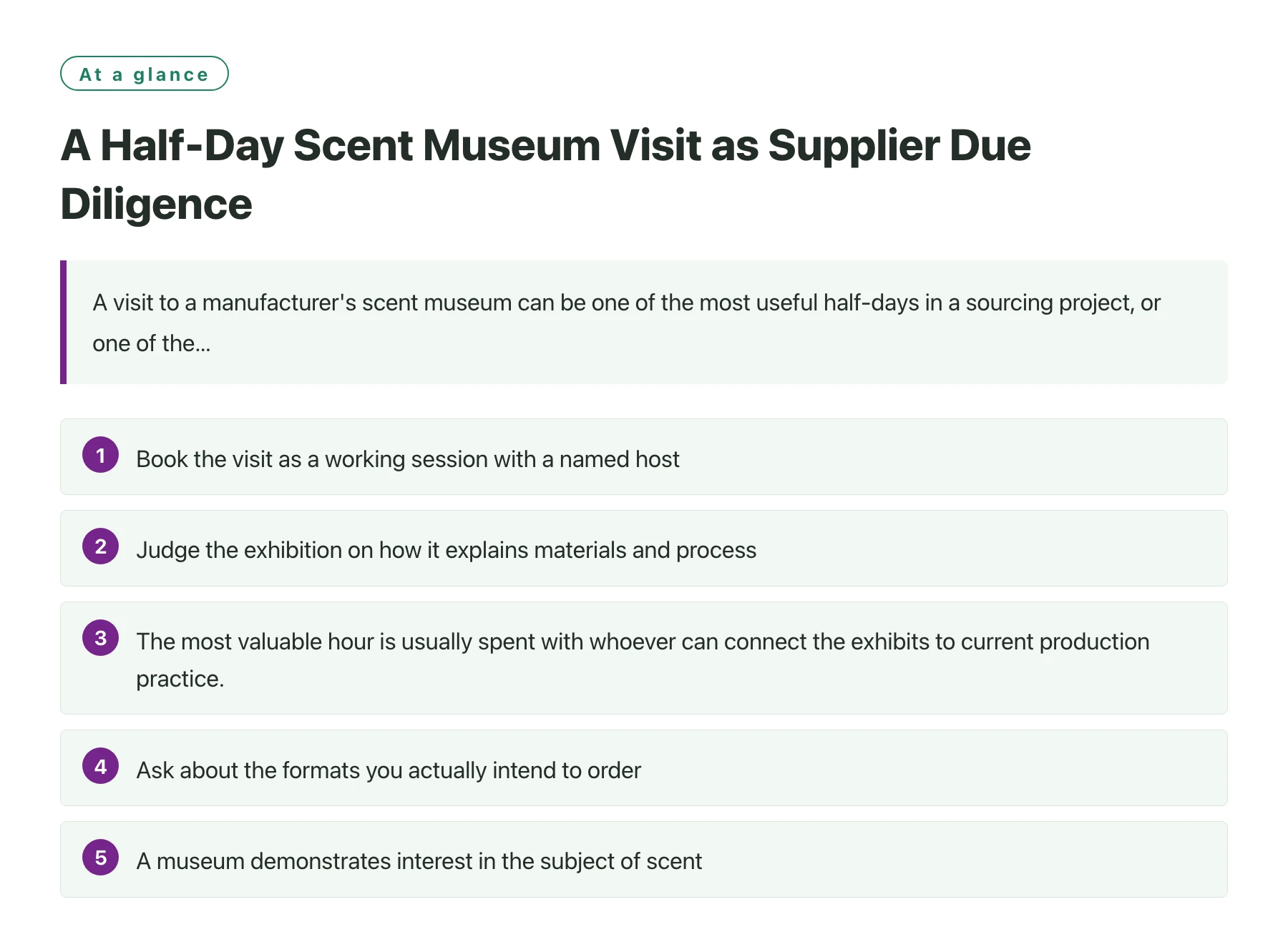
Key takeaways
- Book the visit as a working session with a named host, not as a tour, and ask in advance which areas outside the exhibition are included.
- Judge the exhibition on how it explains materials and process, not on how dramatic it looks in photographs.
- The most valuable hour is usually spent with whoever can connect the exhibits to current production practice.
- Ask about the formats you actually intend to order, including gift and travel presentations, rather than only about the flagship display.
- A museum demonstrates interest in the subject of scent; it does not by itself demonstrate manufacturing capability, and the two claims should be kept separate.
Fragrance museums have become part of how scent manufacturers present themselves. Some are serious institutions with collections, conservation practice and public programming; others are showrooms with mood lighting and a guided script. From a buyer's perspective the difference matters, because one is a research resource and the other is a marketing room.
The good news is that the difference becomes obvious within an hour if you know what to look at. This is an agenda for a half-day visit, written for a buyer who is evaluating a supplier for a gift or travel project and wants the visit to feed a real decision.
Before you book: four requests that shape the day
Send four requests when you confirm the date. First, name the host and that person's role. Second, ask for the running order in advance, including any production, laboratory or packaging areas that can be included. Third, ask whether you may photograph exhibits and take notes. Fourth, ask for one hour with someone who works on current projects, not only with the museum team.
The answers tell you a great deal before you travel. A manufacturer that can name a host, share an agenda and arrange a technical conversation is treating the visit as part of a business relationship. A vague reply suggests that the visit is handled by whoever is free that day.
It is also worth asking how the museum is run. Professional museum practice covers collection care, interpretation and public accountability, and reference material from the museum sector describes what that involves [1]. You do not need to audit an exhibition against those standards, but knowing they exist makes it easier to notice when nobody can explain how the collection is looked after.
What to read on the way in
Take ten minutes at the entrance to read the interpretation panels rather than the logos. Good interpretation tells you where materials come from, how a scent is structured and why particular objects were chosen. Weak interpretation relies on adjectives and the size of the display.
Note the dates. A collection that shows a genuine span of materials tells you the company has been tracking the subject rather than assembling a display for visitors.
What the layout tells you about the company
Look at how the visitor route is ordered. Routes that move from raw material to finished product to factory process mirror how the company thinks about its own work. Routes that move from sparkle to sparkle are usually organised around photographs.
Pay attention to smell management as well. A space where every room smells of the previous one has not solved the core problem of displaying scent, and that is a fair indicator of how carefully other details are handled.
A four-hour agenda
| Time | Where to spend it | What to look for | What it cannot tell you |
|---|---|---|---|
| First 45 minutes | Permanent collection | Interpretation quality, material provenance, dated objects | Whether production runs to a written standard |
| Next 45 minutes | Temporary or olfactory exhibits | How scent is presented without words, and how the visitor is guided | Whether the same care reaches a shipping carton |
| Next 60 minutes | Technical discussion with a project host | Answers about sampling, fill weight and small-format production | Whether the schedule holds under pressure |
| Next 45 minutes | Factory, laboratory or showroom, if offered | Inspection points, batch records, component storage | Whether the museum reflects current practice or history |
| Final 30 minutes | Wrap-up and written questions | Commitments you can hold the supplier to later | Anything the supplier chose not to show you |
The final row matters as much as the others. What is excluded from a visit is information. If production areas are off limits, ask why and whether a later visit can include them; a reasonable answer is usually about scheduling or hygiene rules, and an unreasonable one is about nothing at all.
Converting the visit into a comparison you can use
- Write your notes the same dayImpressions fade within a day, and a museum visit produces a lot of them. Record what you saw, who said what and what you were shown before the details blur.
- Separate exhibit evidence from supplier evidenceKeep two columns: what the museum demonstrates about the company's interest and expertise, and what it demonstrates about its ability to run your order. The second column is the one that decides the project.
- Ask about your format, not the flagshipIf you are planning a gift or travel set, ask how the company handles small formats, decoration and set assembly, and ask to see a relevant example.
- Send a follow-up summaryWrite down what you understood and what was promised, then send it to your host. The reply, or the absence of one, is itself a data point about how the supplier handles documentation.
- Compare like with likeIf you visit two suppliers, use the same agenda and the same questions, so that the resulting notes can be read side by side rather than as two separate stories.
What a museum does and does not prove
A museum is a legitimate signal. It shows a company willing to invest in the subject of scent, and it creates a place where staff, customers and the public can meet the material. Manufacturers with a training arm can use it as a teaching resource, and Xuelei perfumery courses is an example of how education and exhibition can sit inside the same organisation.
None of that substitutes for the checks that decide a production order. A museum does not tell you whether the factory holds an approved reference standard, how it handles a decoration defect, or what happens when a component arrives late. Those questions still belong in the supplier review, and they are answered in documents rather than in exhibitions.
The version of the visit that pays for itself
The most productive outcome of a museum visit is a better brief. Standing in front of raw materials and historical objects is a fast way to sharpen what a brand actually wants to say about its scent, which is worth more than any supplier presentation.
That is why it helps to bring the product team rather than only the sourcing team. A designer who has smelled a material and seen how it was used will write a more specific brief than one who has only read a description.
Where the museum belongs to a manufacturer, the visit also shows how the company describes its own history and scope, which is useful context when reading a capability statement such as Xuelei.
Using the visit to judge scope
Ask during the technical hour how much of a project the company expects to handle. A manufacturer that describes development, filling and packaging as one scope is telling you something about its capacity to manage handoffs, and that claim can be tested the same way any other claim is.
If the company presents itself as offering one-stop fragrance manufacturing, the museum visit is a good place to ask how the exhibition relates to current production, who runs the collection, and whether the same team that understands the materials also signs off on product specifications.
A museum visit is not a shortcut
It is tempting to treat a well-run exhibition as reassurance about everything else. Resist that. The visit is one input among several, and the buyers who get the most from it are the ones who treat it as a briefing and research exercise, then return to the ordinary work of quotations, samples and inspection points.
Visiting Xuelei Museum, for example, will tell you a great deal about how one manufacturer in Guangzhou presents the history and materials of scent; the company describes the site as the largest of its kind. What it will not tell you is whether your particular gift set can be filled, decorated and assembled on the schedule you need. That still has to be asked.
Take one page of questions and leave one page of notes. If the visit ends with a notebook full of impressions and no list of follow-up questions, you have attended a good tour rather than run a supplier assessment. The questions are the deliverable.
Sources
- ICOM — International Council of Museums —— The international organisation representing museums; publishes the ICOM museum definition and professional standards for museum practice.
Frequently asked questions
Is a scent museum visit worth the travel time?
Yes, if it is arranged as a working session with a technical host and you use a fixed agenda. The value comes from smell, materials and conversation, which are difficult to replicate remotely. A visit without an agenda is harder to justify.
What should I ask if production areas are not included in the tour?
Ask why, and whether a second visit can include them. Hygiene, scheduling and safety rules are normal reasons to restrict access. A refusal to explain, or a promise with no date attached, is more informative than the restriction itself.
Can a museum visit replace a factory audit?
No. An exhibition shows how a company presents scent; an audit shows how it controls production. They answer different questions, and a supplier that performs well in one may still need to be checked on the other.
How many suppliers should I visit before choosing one?
Two is usually enough to make the comparison useful, provided you use the same agenda and question list for both. Visiting more suppliers adds impressions without necessarily improving the decision.
Should I bring the product team or only the buyer?
Bring both if the schedule allows. Buyers need the commercial and capability answers, while product and design colleagues benefit from the material and exhibition context, which usually produces a sharper brief.
Ship a brand investors actually remember.
Book a 30-minute call and walk away with a sharp brief, a fixed quote and a delivery date — usually within a fortnight.