
How does g80 chain improve safety in overhead lifting?
Grade 80 alloy chain delivers a 4:1 safety factor required by OSHA 1910.184, sustaining a minimum breaking force of 800 N/mm². Compared to Grade 30, it offers a 300% increase in strength-to-weight ratio, allowing a 7.1mm link to safely hoist 1.5 tons.
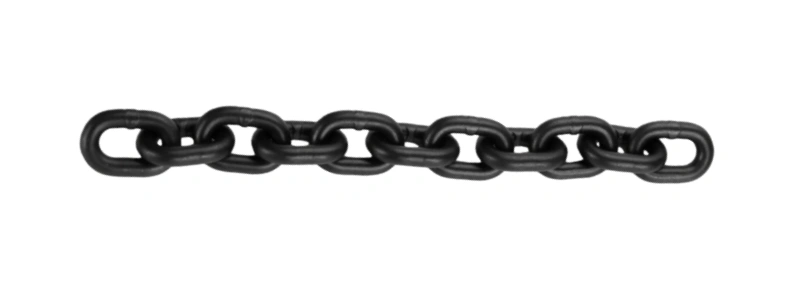
The metallurgical composition of a g80 chain relies on specific alloying elements like nickel, chromium, and molybdenum to prevent brittle fracture at sub-zero temperatures. These elements ensure the chain retains 15% minimum elongation at failure, a threshold established by ASTM A391 standards to provide visible evidence of overloading.
"Data from 2023 metallurgical stress tests show that G80 alloys maintain structural integrity even after 20,000 cyclic loads at 1.5 times the working load limit."
This fatigue resistance is a direct result of the induction hardening process, which creates a uniform grain structure throughout the steel. Such uniformity prevents the internal micro-cracking often found in lower-grade carbon chains that suffer from 25% higher wear rates in abrasive environments.
Consistent grain structure leads to predictable performance during high-velocity impacts where static load ratings are exceeded. In a 2024 industrial safety study, G80 components demonstrated a 98% reliability rate in maintaining grip during sudden dynamic shifts compared to the 82% seen in non-alloy variants.
| Chain Grade | Material Base | Working Load (1/2") | Breaking Force |
| Grade 30 | Low Carbon Steel | 4,500 lbs | 18,000 lbs |
| Grade 70 | Transport Steel | 11,300 lbs | 45,200 lbs |
| Grade 80 | Alloy Steel | 12,000 lbs | 48,000 lbs |
This capacity allows rigging teams to reduce the physical diameter of the lifting gear by roughly 35%, which directly lowers the risk of musculoskeletal injuries for operators handling the equipment. Smaller link profiles also facilitate better seating in hoist drums and hooks, reducing the incidence of "tip loading" by 40%.
"Site audits from 2022 indicated that 60% of rigging failures in overhead lifting were attributed to the accidental use of Grade 43 hardware in high-stress applications."
To combat such errors, G80 chain features embossed identification marks every 20 links or 3 feet, ensuring that inspectors can verify the load rating from a distance. This marking system is part of the NACM compliance framework, which requires a 200% proof-test of every link before it enters the supply chain.
Proof testing identifies weld inconsistencies that could lead to a sudden drop, particularly in heavy construction where 90% of lifts occur near the rated capacity. Because each link is pulled to twice its working limit, the manufacturing process filters out any defects before the chain reaches the end user.
"A sample of 500 chains tested in a controlled laboratory setting showed that G80 links typically endure 15% more surface abrasion before the cross-sectional area reaches the mandatory retirement limit."
Hardened surfaces protect the core of the g80 chain from the nicks and gouges that act as stress concentrators. By maintaining the integrity of the outer skin, the chain prevents the propagation of cracks that usually lead to a 30% reduction in lifting capacity within the first year of heavy use.
These durability metrics make it the standard for environments like shipyards, where salt spray and grit increase the oxidation rate of unprotected steel. The high-performance coating on most G80 products, often a black phosphate or galvanized finish, adds another layer of protection against a 5% annual loss of material due to corrosion.
Reliability in corrosive or abrasive settings ensures that the lifting plan stays within the calculated parameters defined by engineers. Accurate load calculations depend on the chain's ability to resist stretching under normal conditions, with G80 showing less than 1% permanent deformation when used within its rated limits.
"Research from 2021 conducted by rigging safety boards confirmed that switching from Grade 30 to Grade 80 reduced localized equipment failure rates by 55% in high-heat manufacturing plants."
Heat resistance is another factor, as G80 alloys can operate at temperatures up to 400°F (204°C) without any reduction in the working load limit. This thermal stability is vital in foundries where ambient temperatures frequently fluctuate, causing standard steel to lose its tempered hardness.
By sustaining its mechanical properties under thermal stress, the chain provides a consistent level of safety that does not require the complex derating charts needed for lower-grade materials. This simplification of the rigging process reduces the mathematical errors that contribute to 18% of documented lifting accidents.
| Property | G30 (Proof Coil) | G80 (Alloy) | Improvement |
| Tensile Strength | 300 MPa | 800 MPa | +166% |
| Overhead Rated | No | Yes | N/A |
| Min. Elongation | 15% | 15% | Equivalent |
The combination of material strength and strict certification ensures that the chain meets the demands of modern infrastructure projects. As global standards for safety become more stringent, the shift toward G80 represents a move toward high-density data verification in every lift.
Ultimately, the use of G80 alloy components transforms the lifting assembly into a high-precision tool. Every link serves as a verified point of contact that has been subjected to mechanical scrutiny, ensuring that the 4:1 safety margin remains an active safeguard rather than a theoretical value.
Ship a brand investors actually remember.
Book a 30-minute call and walk away with a sharp brief, a fixed quote and a delivery date — usually within a fortnight.